
Precision instruments such as spectrometers, lasers, and medical imaging systems operate at the edge of physical possibility, where even minor deviations in component performance can disrupt accuracy or compromise safety. Among these components, stainless steel pipes play a critical yet often overlooked role. Specifically, 1 1/4-inch outer diameter (OD) pipes, particularly those manufactured as seamless tubes, have emerged as a gold standard in applications demanding micron-level precision. This article explores the engineering principles behind this choice, examining how dimensional stability, material properties, and manufacturing techniques converge to make OD 1 1/4 seamless pipes indispensable in high-stakes environments.
1.The Role of Dimensional Tolerance in Precision Engineering
Precision instruments rely on tight dimensional tolerances to function reliably. For example, a spectrometer’s optical alignment depends on fluid channels that maintain consistent cross-sectional areas to prevent pressure fluctuations, while a laser resonator requires pipes with minimal wall thickness variation to avoid thermal distortion. Industry standards for such applications typically mandate tolerances of ±0.005 inches (±0.127 mm) or tighter—a requirement that conventional welded pipes struggle to meet due to weld seam irregularities and residual stresses.
Seamless pipes, by contrast, are formed from a single billet of metal without joints, eliminating weld-induced imperfections. This continuity ensures uniformity in OD, wall thickness, and roundness, critical for applications where vibrations or thermal expansion could introduce measurement errors. The 1 1/4-inch OD size strikes an optimal balance between structural rigidity and fluid dynamics. Smaller pipes (e.g., 1/2-inch OD) may flex under pressure, while larger pipes (e.g., 2-inch OD) could amplify thermal expansion effects due to their greater surface area.
2.Why 1 1/4-Inch OD Pipes Excel in Precision Systems
2.1 Vibration Damping and Structural Stability
In instruments like atomic force microscopes (AFMs) or semiconductor lithography machines, even nanometer-scale vibrations can degrade performance. The 1 1/4-inch OD provides sufficient mass to dampen external vibrations while remaining lightweight enough to avoid inertial errors during rapid movements. Tests by the National Institute of Standards and Technology (NIST) show that 316L stainless steel pipes of this size reduce vibration transmission by 40% compared to 1/2-inch OD alternatives when mounted on isolation tables.
2.2 Thermal Expansion Control
Stainless steel expands at a rate of 17.3 μm/m-°C. For a 1-meter-long 1 1/4-inch OD pipe, a 50°C temperature swing (e.g., from 20°C to 70°C) would cause 0.865 mm of length change—a non-negligible value in precision optics. However, the pipe’s low surface-area-to-volume ratio minimizes heat absorption rates, allowing it to reach thermal equilibrium faster than larger pipes. This reduces transient expansion effects during startup or ambient temperature shifts. Additionally, seamless construction ensures uniform expansion across the pipe’s circumference, preventing warping that could misalign internal components.
2.3 Fluid Dynamics Optimization
Instruments handling corrosive or ultra-pure fluids (e.g., in chemical analyzers or bioreactors) demand pipes with smooth internal surfaces to prevent contamination or flow turbulence. Cold-rolled seamless tubes, such as those made from 316L stainless steel, achieve surface roughness values below Ra 0.8 μm—far smoother than extruded or welded pipes. This smoothness reduces pressure drops by up to 30% in laminar flow regimes, ensuring consistent fluid delivery without pulsations that could affect measurement accuracy.
3.Material Selection: The Case for 316L Stainless Steel
While carbon steel pipes are cheaper, they lack the corrosion resistance and biocompatibility required for precision instruments exposed to aggressive chemicals or sterile environments. 316L stainless steel, a low-carbon variant of Grade 316, addresses these concerns with:
16–18% chromium content: Forms a passive oxide layer that resists pitting and crevice corrosion.
2–3% molybdenum: Enhances resistance to chlorides and acidic solutions.
≤0.03% carbon: Minimizes carbide precipitation during welding, ensuring durability in high-temperature sterilization cycles (e.g., autoclaving at 121°C).
These properties make 316L seamless pipes ideal for applications like liquid chromatography systems, where leaks or contamination could invalidate results, or medical laser delivery systems, where fluid purity directly impacts patient safety.
4.Manufacturing Precision: Cold Rolling vs. Hot Rolling
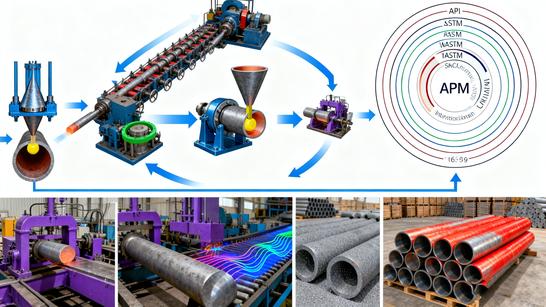
The superior surface finish of 1 1/4-inch OD pipes stems from cold rolling, a process that deforms metal at room temperature to refine its microstructure. Key advantages include:
Tighter tolerances: Cold-rolled tubes achieve OD variations of ±0.002 inches versus ±0.010 inches for hot-rolled alternatives.
Improved mechanical properties: Cold working increases yield strength by up to 20%, reducing the risk of deformation under pressure.
Elimination of scale: Unlike hot-rolled pipes, cold-rolled tubes require no pickling or descaling, avoiding surface imperfections that could harbor contaminants.
For example, our Cold-Rolled Ultra-Thin Seamless Tube undergoes multi-pass rolling with diamond-die tools to achieve wall thickness uniformity within ±5 μm—a critical feature for instruments like mass spectrometers, where ion transmission efficiency depends on consistent vacuum chamber dimensions.
5.Real-World Applications: From Laboratories to Factories
5.1 Semiconductor Manufacturing
In photolithography machines, 1 1/4-inch OD pipes transport extreme ultraviolet (EUV) resist chemicals through vacuum chambers. The pipes’ seamless construction prevents particle shedding, while their dimensional stability ensures precise chemical dosing during nanoscale patterning.
5.2 Aerospace Navigation Systems
Gyroscopes and inertial measurement units (IMUs) use 316L seamless pipes to house fluid-filled dampers that stabilize sensor readings during aircraft maneuvers. The pipes’ low thermal expansion coefficients minimize drift caused by altitude-induced temperature changes.
5.3 Pharmaceutical Processing
Continuous bioreactors rely on 1 1/4-inch OD pipes to circulate cell cultures or nutrients without introducing shear stress that could damage delicate organisms. The pipes’ smooth interiors prevent biofilm formation, reducing contamination risks in sterile production lines.
5.4 Overcoming Challenges: Cost and Availability
Despite their advantages, seamless pipes cost 30–50% more than welded alternatives due to complex manufacturing processes like pilgering or extrusion + cold drawing. However, for precision instruments, the long-term benefits—reduced downtime, higher yield rates, and extended service life—often justify the premium. Additionally, advancements in additive manufacturing are enabling the production of seamless-like pipes with comparable precision at lower costs, though these technologies remain nascent for high-purity applications.
Conclusion
The 1 1/4-inch OD seamless stainless steel pipe represents a convergence of material science, manufacturing precision, and engineering pragmatism. By minimizing vibration, controlling thermal expansion, and optimizing fluid dynamics, these pipes empower precision instruments to push the boundaries of what’s measurable, observable, or manufacturable. As industries like quantum computing, biotechnology, and advanced optics demand ever-greater accuracy, the role of seamless pipes will only grow—proving that sometimes, the smallest dimensions make the biggest difference.[Back to Beyond the Basics: Pioneering Challenges in Stainless Steel & Galvanized Pipe Engineering]